Munich, February 11, 2026 – This week the World Food Programme (WFP) will spotlight the breakthrough solutions that are transforming how humanitarian and development assistance is delivered as food insecurity intensifies globally. On February 12, 2026, the WFP Innovation Forum 2026: Innovating for Impact, an official side event of the Munich Security Conference, brings together government, private sector and philanthropic leaders, innovators and partners — showcasing eight innovative, scalable solutions to catalyze new investment and partnerships to accelerate their impact.
With as many as 318 million people facing acute hunger around the world, the WFP Innovation Forum, hosted by the WFP Innovation Accelerator, fosters innovation in strengthening food systems, supporting emergency response and improving the efficiency of humanitarian operations. Since its establishment in 2015, the WFP Innovation Accelerator has supported more than 500 ventures and innovation teams across over 90 countries and territories, catalyzing over $382 million in funding and making sure solutions reach more than 104 million people in 2025 alone.
The cutting-edge solutions that will be featured at this year’s WFP Innovation Forum in Munich include:
- End‑to‑end Supply Chain Optimization: A connected planning system that turns forecasts into smarter, continuously optimized sourcing and delivery decisions. Within this system, SCOUT, an Artificial Intelligence tool, helps WFP determine where best to buy food, where to send it, where to store it and how to deliver it on time. Over two years, SCOUT has saved over $6 million. As it scales, SCOUT is projected to save over $25 million annually. The money saved translates directly into more meals, faster delivery and greater resilience for families facing hunger.
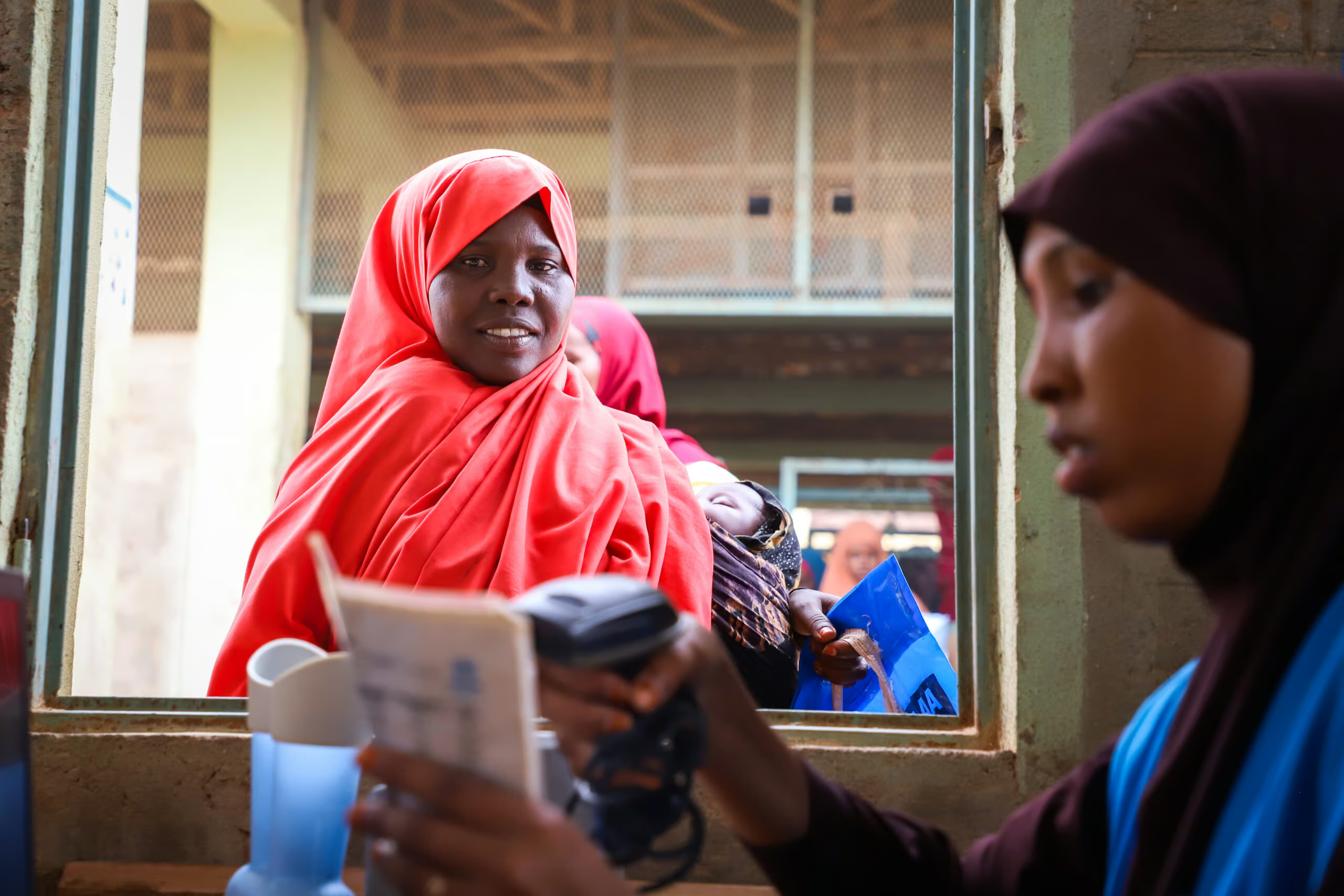
- People Portal: WFP’s self‑registration platform enables people in crisis to sign up for humanitarian assistance remotely and allows for WFP to reach more people faster, even in areas with limited or no physical access. In Gaza, 2 million people registered remotely, saving $9.4 million as registration costs dropped from $12 to $0.50 per household. At scale, the solution aims to generate up to $115 million in annual savings. It is already supporting some of WFP’s most complex emergencies, including Gaza, Ukraine and Sudan.
- Conflict Forecast: A predictive analytics tool, enhances early warning systems by identifying emerging conflict risks, enabling earlier planning and more proactive responses for essential services and humanitarian operations. Already deployed in Somalia, conflict forecast aims to generate cost savings of up to $1 million per country.
- Jangala: A portable, open‑source device that turns any internet source into fast, scalable Wi‑Fi for emergencies and communities. Fully open source, it supports both small field teams and large‑scale deployments for communities or refugee camps of over 10,000 people. Jangala has deployed 64 Big Box units, providing Wi‑Fi to 39 schools, 22 community projects and 3 emergency teams, serving about 48,000 people.
- Anomaly Detection for Assistance Delivery: An AI system that detects irregularities in beneficiary information and transfer management platforms to improve data quality, strengthen fraud prevention and ensure better support for underserved households. Scaling this system will enhance fraud detection, improve data quality and financial assurance and increase transparency and efficiency in assistance delivery.
- Remer: A formula that enhances soil health, increases yields and reduces the need for pesticides and chemical fertilizers and cuts fertilizer needs by 70%, offering a competitive and more affordable price in the markets. In 2025, Remer partnered with Lebanon’s Ministry of Agriculture to promote sustainable practices country‑wide and is now expanding research and development, with plans to launch “Growth Powder” and additional products in 2026.
- Inclusive Risk Financing (IRF): A bundled financial‑protection package that helps vulnerable households withstand and recover from shocks. In 2024, IRF reached 3.1 million people across 19 countries, providing $250 million in financial protection and $41.5 million in payouts.
- School Connect: A real‑time digital monitoring tool that strengthens accountability and improves decision‑making in school feeding programs. Since 2020, it has captured data from over 11,000 schools in 25 countries, tracking over 350 million meals for 3.6 million children. The team aims to support School Meals Coalition countries over the next two years, with the ambition for WFP to lead the global digitalization agenda by 2030.
As the 2020 Nobel Peace Prize laureate, WFP brings a uniquely authoritative voice to this conversation, emphasizing the connection between food security and peace, and reinforcing why bold, scalable solutions are needed now more than ever.
Building on that mandate, the WFP Innovation Accelerator is harnessing emerging technologies such as artificial intelligence and blockchain to help humanitarian and development actors operate more effectively amid conflict, extreme weather and economic volatility. Its work reflects a growing recognition across the sector that new technologies and approaches are essential to meeting rising global needs.
This effort is supported by long‑standing partnerships with the German Federal Ministry for Economic Cooperation and Development (BMZ), the German Federal Foreign Office (GFFO) and the Bavarian State Ministry of Food, Agriculture, Forestry and Tourism (StMELF), as well as many governments like France, Luxembourg, Austria and private sector partners such as BASF Stiftung, John Deere and Google .
“The commitment of longstanding partners has enabled WFP to turn Munich into one of the world’s leading hubs for global humanitarian and development innovation,” said Bernhard Kowatsch, director of WFP global accelerator and ventures. “The innovations showcased at this forum demonstrate what is possible when new technology like AI, local expertise across the world and great innovators come together.”
About the WFP Innovation Forum
The WFP Innovation Forum brings together representatives from government, the humanitarian sector, academia and the private and philanthropic sector to accelerate the development and scale‑up of impactful solutions addressing challenges ranging from conflict‑driven displacement to extreme weather events and rising food insecurity.
Register now to join the livestream and be part of the global conversation on scaling innovative solutions for greater humanitarian impact: WFP Innovation Forum